Surfaces That Handle Daily Vehicle Weight
Concrete Driveways in Muskegon for properties requiring durable vehicle access and expanded parking capacity
Mckinley Concrete LLC installs new concrete driveways, expansions, aprons, and approach sections across the Muskegon area, addressing situations where asphalt deterioration, gravel maintenance, or inadequate parking space create ongoing problems. Residential driveways built with proper thickness, reinforcement, and base preparation withstand freeze-thaw cycles common near Lake Michigan while supporting pickup trucks, recreational vehicles, and boat trailers without rutting or settling. Properties with culvert installations or grade transitions require careful planning to maintain positive drainage and prevent ponding at the foundation line.
New driveway construction begins with evaluating soil conditions, removing unstable material, and compacting a granular base to create stable support beneath the slab. Four-inch residential concrete works for standard passenger vehicles, but homes that regularly park heavier vehicles—campers, work trucks, or equipment trailers—often benefit from six-inch construction with additional rebar to distribute loads more effectively. Final thickness depends on your specific vehicle use, soil characteristics, and existing grade conditions.
Request a driveway estimate that accounts for your property's dimensions, vehicle requirements, and site-specific grading needs.
What Proper Driveway Construction Requires
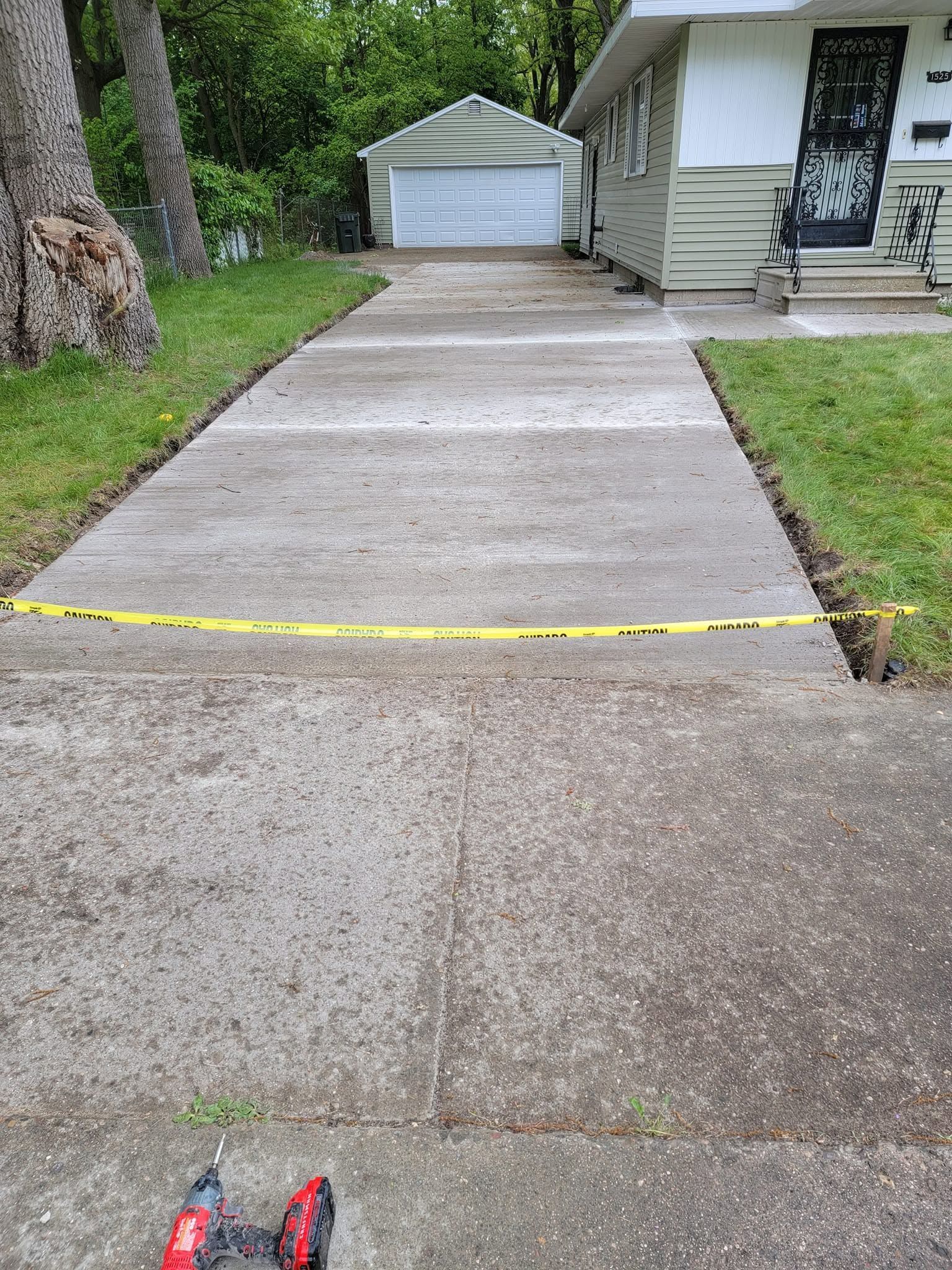
Mckinley Concrete LLC pours driveways using 4,000 PSI concrete mixes and installs rebar grids designed to handle tensile stress as the slab expands and contracts with temperature swings. Control joints are cut at regular intervals to direct cracking along planned lines rather than allowing random fractures across the surface. Drainage grading ensures water flows away from garage entries and foundation walls, preventing ice buildup in winter and standing water during heavy rain events common to the lakeshore region.
After the pour is complete and initial finishing is done, the concrete requires several days of curing before vehicle traffic can safely use the surface. You will notice a stable, level driving lane that eliminates potholes, gravel scatter, and the uneven surfaces that cause suspension wear and difficulty maneuvering trailers. Properly placed control joints remain tight and clean, and the surface sheds water toward yard areas or drainage inlets rather than pooling near the house.
Expansions and apron sections integrate with existing driveways or garage floors through careful joint planning and elevation matching, ensuring smooth transitions without trip hazards or abrupt edges. Culvert-area work involves coordinating slab edges with pipe placement and ensuring adequate cover depth to prevent cracking over the culvert line as vehicles pass overhead.
Common Questions About This Service
Driveway projects in the Muskegon area often involve questions about material specifications, timing, and site preparation before the first yard of concrete arrives.
What determines whether a driveway needs four-inch or six-inch concrete?
Standard passenger cars and light trucks perform well on four-inch slabs with proper base preparation, but properties that regularly park boats, campers, or commercial vehicles benefit from six-inch construction to distribute concentrated axle loads and reduce cracking risk over time.
How long does the concrete need to cure before vehicle use?
Most residential driveways require at least seven days of curing before you can drive on them, though exact timing depends on ambient temperature and humidity conditions during the finishing period.
What role does the compacted base play in driveway performance?
A well-compacted granular base prevents settling and voids beneath the slab, ensuring uniform support that reduces the likelihood of cracking as freeze-thaw cycles stress the concrete each winter in Muskegon.
Why are control joints necessary in a driveway?
Control joints create planned weak points that direct cracking along intentional lines as the slab expands and contracts, preventing random fractures from developing across the driving surface.
What site preparation happens before concrete placement?
Excavation removes unstable topsoil, grading establishes proper slope away from structures, and base material is spread and compacted to create a stable platform that supports the slab evenly across its entire footprint.
Mckinley Concrete LLC evaluates your property's soil conditions, vehicle use patterns, and drainage requirements to develop an accurate driveway estimate. Schedule a site consultation to review layout options, thickness specifications, and approach details for your project.